Overview
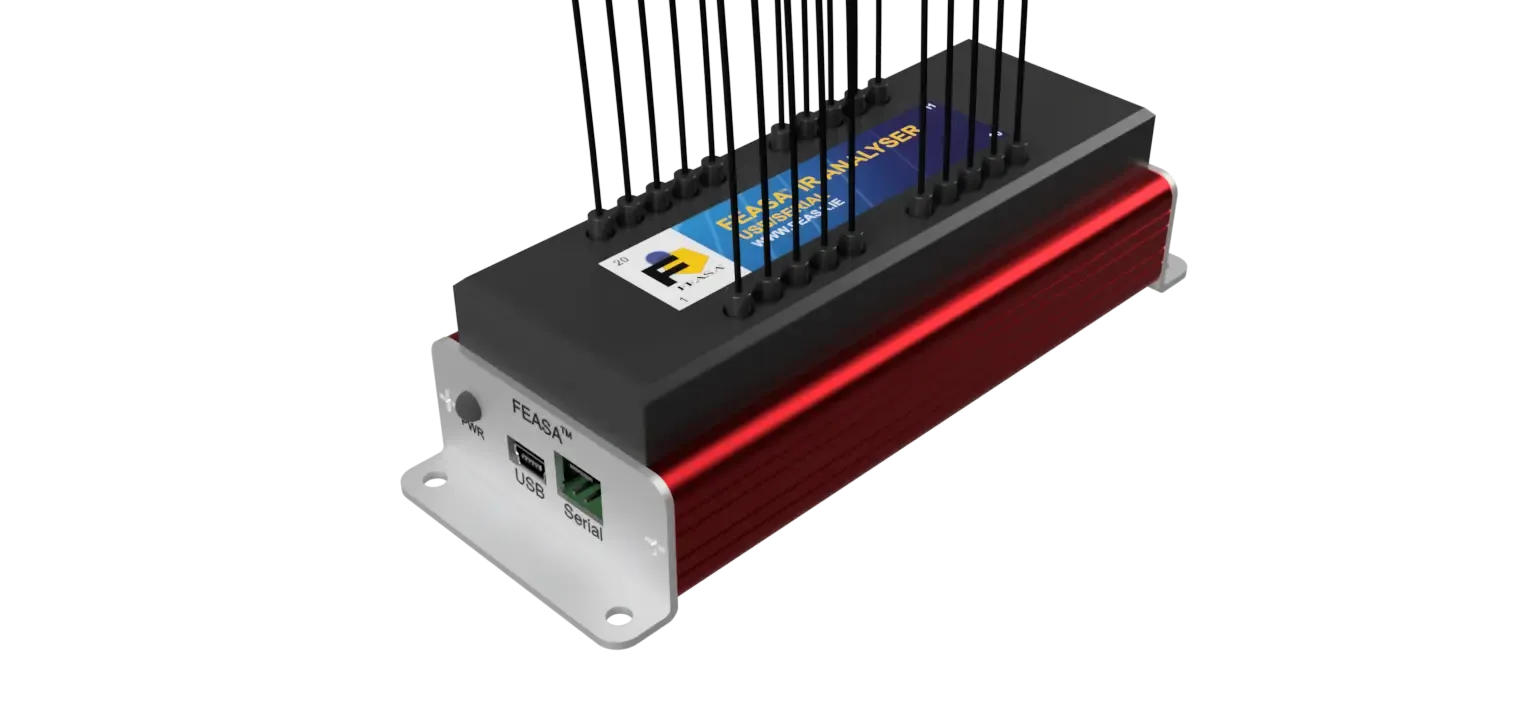
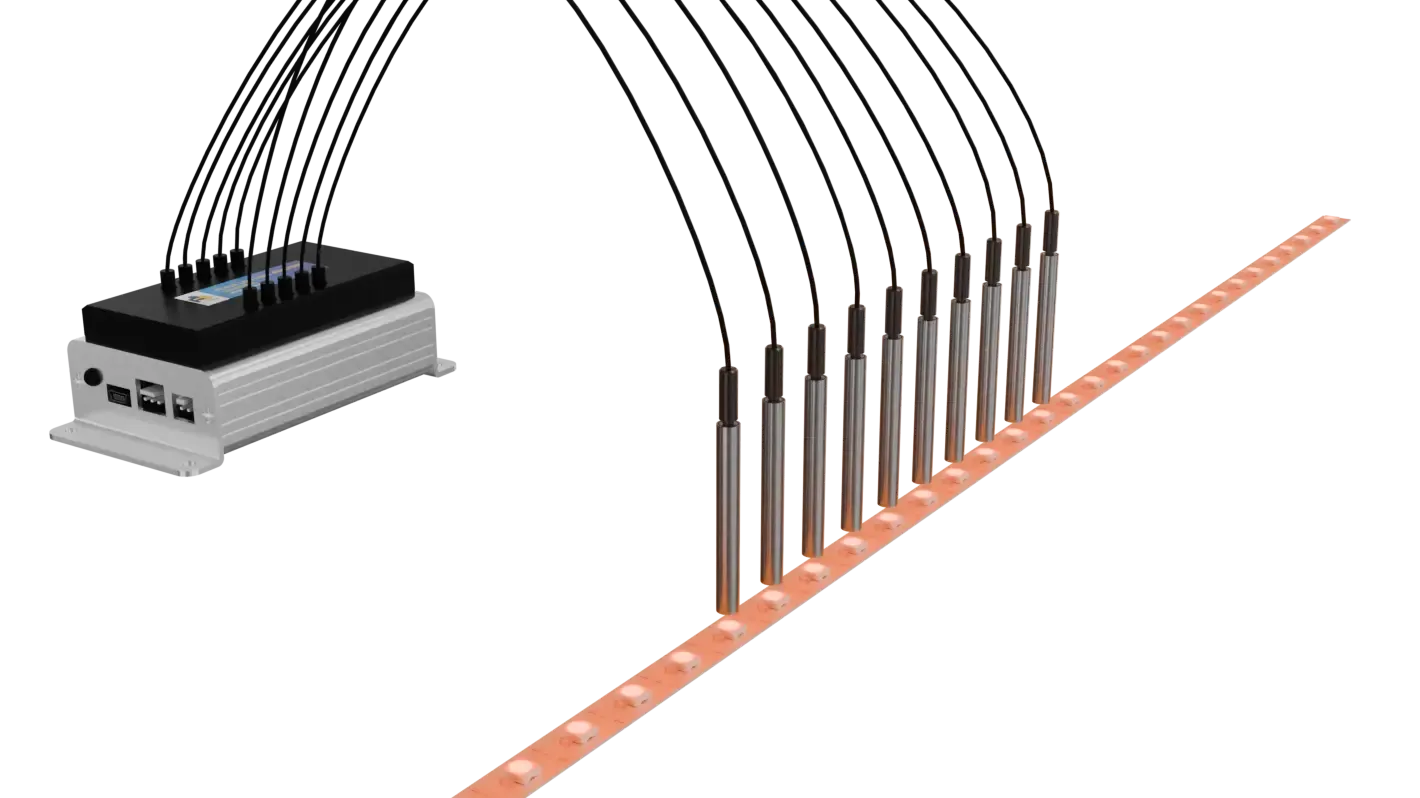
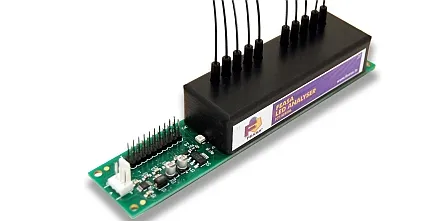
The Feasa Infrared LED Analyser is a multichannel instrument for fast, repeatable wavelength and intensity measurement of infrared LEDs and sources in a production environment. Operating across the 700–950nm range, it is used to verify IR LED performance in automotive sensing systems, security and surveillance equipment, and industrial applications.
The analyser uses specially selected and prepared optical fibre — glass or plastic depending on the wavelength range and fixture requirements — in conjunction with the OH-8IR optical head, which has been specifically designed for infrared LED testing to ensure stability and repeatability of measurement. Up to 3, 10 or 20 LEDs are measured simultaneously in a single capture cycle.
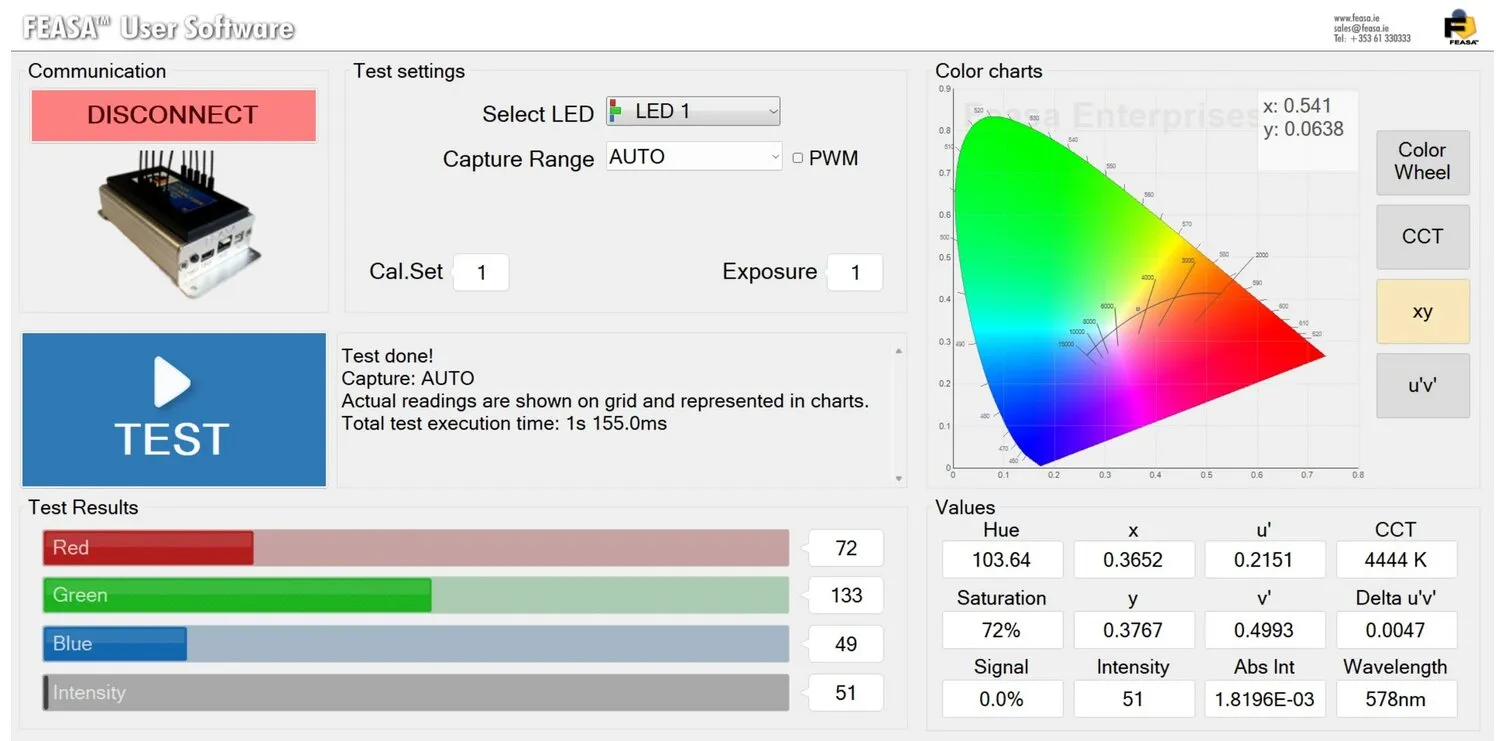
It connects via USB or RS232 and supports Daisy Chain for scaling up to 30 units from a single port. The User Gains Software allows per-channel intensity adjustment to compensate for small variations in fibre output — automatically or manually — ensuring consistent measurement across all channels.
Built for infrared. Trusted globally.

700–950nm infrared range
The only Feasa analyser that operates in the infrared spectrum. Covers the full range of IR LED applications from near-infrared (NIR) sensing through to security illumination and LiDAR sources. Glass fibre extends range to 950nm; plastic fibre covers 700–900nm.

Glass or plastic fibre choice
Glass fibre (1.1mm, 50mm bend radius) covers the full 700–950nm range. Plastic fibre (1.0mm, 15mm bend radius) covers 700–900nm and offers greater flexibility for tight fixture geometries. Both use the same analyser unit — specified at order.

Per-channel intensity calibration
The User Gains Software provides automatic or manual per-channel intensity adjustment to compensate for small variations between fibres. Adjustments are saved to file and recalled on next use — maintaining consistency across the full channel count.

40+ years expertise
Engineering LED test solutions since the early 2000s, headquartered in Limerick, Ireland.

Millions of LEDs daily
Tested every day worldwide via Feasa systems across automotive, security and industrial production lines.

ISO 9001 certified
Full in-house design, development and manufacturing. Deployed in 30+ countries worldwide.
Applications
Where our Infrared Analyser is commonly used.

Automotive Sensing
Rain Sensors, ADAS and LiDAR
Security & Surveillance
IR Illumination Arrays
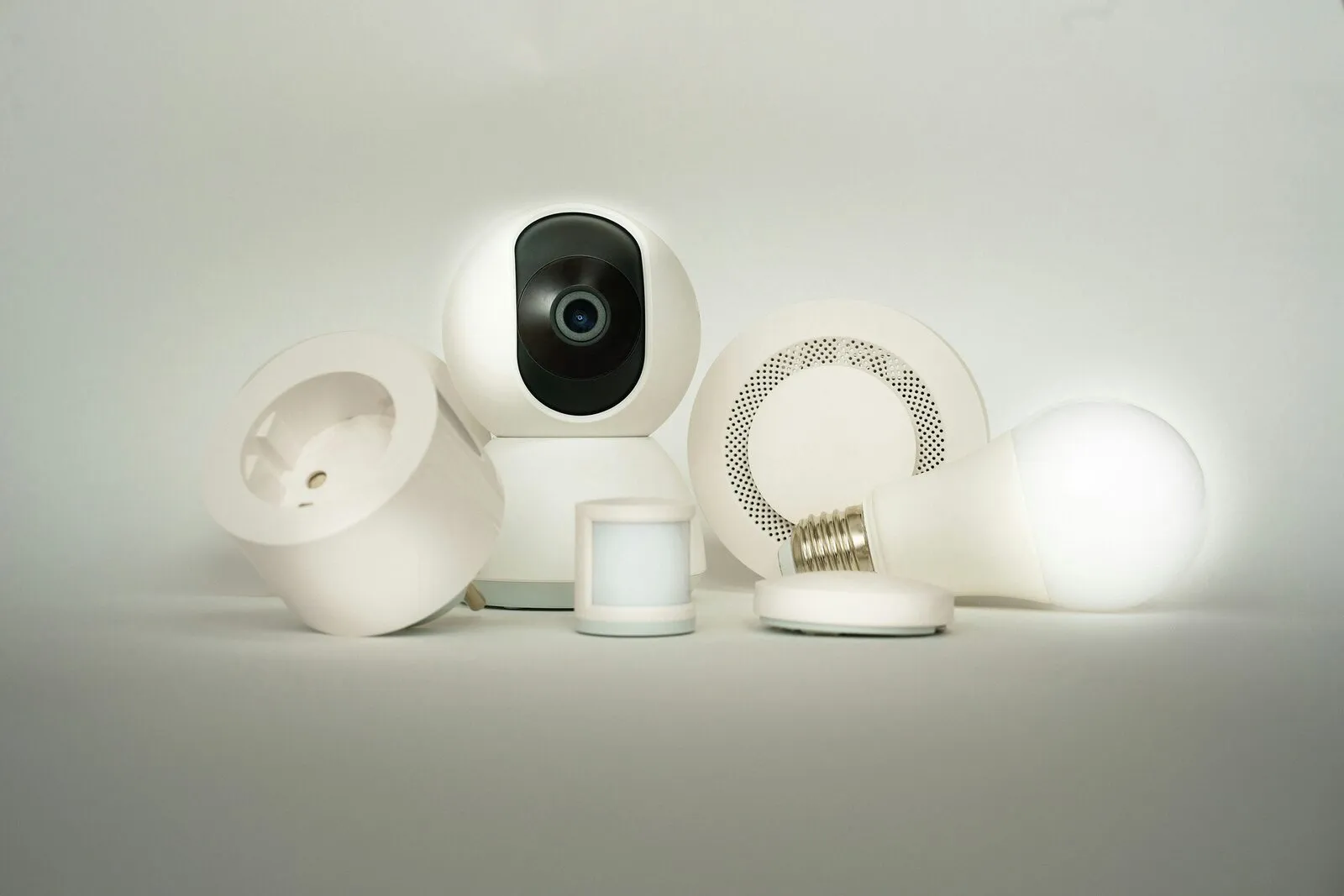
Industrial Sensing
Proximity and Object Detection
Industry & Education
IR Grids, Whiteboards and R&D
Technical Specifications
| 参数 | 数值 | 备注 |
|---|---|---|
| Channels | 3, 10, 20 | Simultaneous measurement |
| Wavelength range — glass (IR) | 700–950 nm | Full IR range |
| Wavelength range — plastic (IRP) | 700–900 nm | NIR range only |
| Wavelength accuracy (700–750nm) | ±30 nm | |
| Wavelength accuracy (751–900nm) | ±10 nm | Best accuracy band |
| Wavelength accuracy (901–950nm) | ±30 nm | Glass fibre only |
| Wavelength repeatability | < 1 nm | Excellent consistency |
| Intensity repeatability | < 1% | Precision measurement |
| Supply voltage | 5.0V | USB bus powered |
| Supply current | 180 mA | Low power consumption |
| Dimensions (3 & 10 ch) | 104.5 × 54 × 39 mm | Compact design |
| Dimensions (20 ch) | 145 × 54 × 39 mm | Larger multichannel |
| Fiber diameter — glass | 1.1 mm | IR model |
| Fiber diameter — plastic | 1.0 mm | IRP model |
| Min. bend radius — glass | 50 mm | More rigid than plastic |
| Min. bend radius — plastic | 15 mm | More flexible for tight geometries |
| Operating temperature | 0–50°C | Industrial range |
| Interface | USB 2.0, RS232, Daisy Chain | Up to 30 units per port |
| Required optical head | OH-8IR (or OH-8A-IR) | Not interchangeable with visible heads |
| Compliance | CE, RoHS | EU standards |
| Model numbers — glass | 3IR · 10IR · 20IR | 700–950nm |
| Model numbers — plastic | 3IRP · 10IRP · 20IRP | 700–900nm |
Feasa Terminal + User Gains Software
Both included with every analyser
- Feasa Terminal — Command-line control with script processor and command save/recall
- User Gains Software — Automatic or manual per-channel intensity adjustment
- Saved adjustments — Adjustments saved to file and recalled on subsequent sessions
- LabVIEW drivers — Provided for NI platform integration
- DLL — Custom testing integration in C, C++, Python
- Connectivity — USB and RS232 compatible — Daisy Chain for multi-unit systems
Downloads and Resources

Product Datasheet
LabVIEW Drivers
ZIP